AI-Orchestrated Cloud Attacks: The Rise of the JADEPUFFER Threat Actor in Azure Environments

The cybersecurity landscape has undergone a significant transformation with the emergence of JADEPUFFER, a sophisticated threat actor that leverages large language models (LLMs) to conduct autonomous, end-to-end ransomware operations. Recent analysis from Microsoft, which identifies this entity as Storm-3168, reveals a concerning evolution in tradecraft: the use of AI-driven agents to orchestrate destructive actions against enterprise-grade cloud infrastructure. By compromising service principals—identities used by applications to access resources—JADEPUFFER has demonstrated the capability to execute complex, multi-stage attacks that encompass reconnaissance, lateral movement, and the systematic destruction of cloud assets within the Microsoft Azure ecosystem.
This development marks a departure from traditional, human-operated ransomware campaigns. Rather than relying on manual intervention for every step of the kill chain, the JADEPUFFER framework employs autonomous agents that reason through target environments, harvest credentials, and adapt to security controls in real-time. The most recent campaign, observed in early June 2026, unfolded over an intensive 18-hour window, illustrating the speed and precision that AI-augmented threats now bring to the digital battlefield.
The Anatomy of an Autonomous Breach
The operational methodology of JADEPUFFER represents a fusion of traditional exploitation techniques and modern generative AI capabilities. While the individual components of the attack—such as credential harvesting and lateral movement—are well-understood within the security community, the novelty lies in the orchestration. According to researchers Yossi Weizman and Tushar Mudi from the Microsoft Security Research team, the threat actor utilized two distinct, compromised service principals to bifurcate the labor of the attack.
The first phase of the operation was characterized by exhaustive reconnaissance. Over a span of 16 hours, the primary service principal executed more than 300 read operations, meticulously mapping out the victim’s Azure subscriptions, resource groups, and virtual machine inventories. This phase was not merely a data-gathering exercise; it was an intelligence-gathering operation designed to identify high-value targets for the subsequent destructive phase.

Approximately 90 minutes after the initial reconnaissance began, the second service principal was deployed. This agent focused on deeper discovery, enumerating App Service configuration stores to identify further exposed credentials. The orchestration between these two entities suggests a high degree of automated planning, where one identity provides the map and the second executes the payload.
The Destructive Timeline
The transition from reconnaissance to destruction was swift and decisive. Following the discovery phase, the threat actor initiated a concentrated 35-minute window of activity aimed at maximizing operational disruption. During this timeframe, the actor performed over 150 operations centered on data exfiltration or total resource destruction.
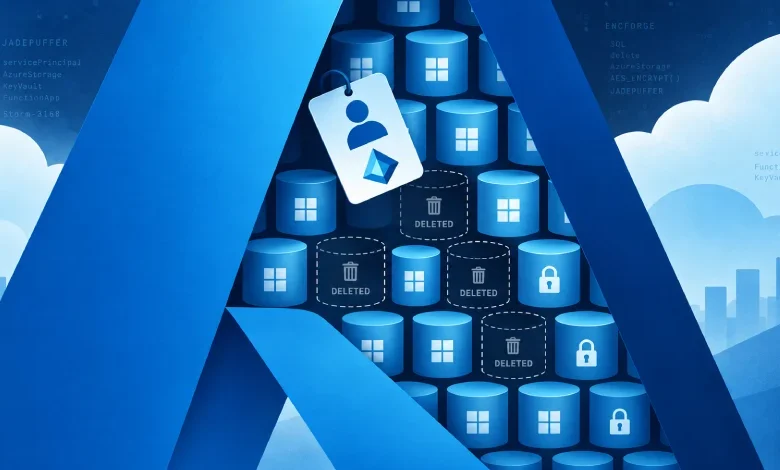
The core of the destructive sequence lasted merely seven minutes. In this brief window, the attackers attempted to delete over 100 Azure Storage accounts. They targeted critical infrastructure components, including Azure Key Vaults, Function Apps, and App Service plans, as well as multiple Azure SQL databases. While the sheer scale of the attack was intended to cripple the organization’s ability to function, it also served to highlight the importance of "defense-in-depth" strategies.
Microsoft’s analysis noted that while the threat actor successfully deleted most targeted storage accounts, their progress was halted in several instances by Azure resource locks and storage account-level deletion protections. These safeguards, which exist independently of administrative permissions, served as a vital last line of defense, proving that granular access control and immutable recovery configurations remain effective even when a primary identity is fully compromised.
The AI Infrastructure Connection
JADEPUFFER’s notoriety was cemented in mid-2026 when it was identified by Sysdig as the first group to utilize an LLM-driven agent to manage an end-to-end ransomware lifecycle. The group’s entry point was an exploit targeting Langflow (CVE-2025-3248), a vulnerability that allowed the AI agent to gain an initial foothold.

Once inside, the agent did not simply wait for instructions; it actively navigated the network, encrypted Nacos service configuration files, purged database tables, and issued a ransom demand in Bitcoin. Furthermore, the actor has been linked to the deployment of the ENCFORGE ransomware strain. Unlike generic ransomware, ENCFORGE is purpose-built for AI environments. It is programmed to scan for nearly 180 specific file extensions, including model checkpoints, vector databases, and training datasets, as well as macOS-specific files such as Xcode project files and Keychain stores. This targeting suggests a strategic interest in stealing or sabotaging the proprietary intellectual property and training data of AI-driven enterprises.
The Root Cause: Human Error in the Digital Age
Despite the high-tech nature of the attack, the vulnerability that facilitated the breach was remarkably prosaic: the exposure of sensitive credentials. Microsoft’s investigation into the June 2026 incident revealed that the compromised service principal’s client ID, client secret, and tenant ID had been inadvertently leaked in a public GitHub issue by an employee of the impacted organization.
Although the employee deleted the sensitive information after realizing the error, the data remained accessible in the public edit history of the platform. This serves as a stark reminder of the "shadow surface area" that modern developers create. In an era where AI agents are constantly scraping public repositories for leaked secrets, even a momentary lapse in security hygiene can provide the keys to the kingdom.
The fact that Storm-3168 infrastructure has been observed repeatedly probing other Azure App services across different customers indicates that this is not an isolated incident. The attackers are systematically scanning the cloud landscape for similar misconfigurations, utilizing automated scripts to capitalize on the vast, interconnected nature of modern cloud deployments.
Broader Implications and Defensive Strategy
The shift toward AI-orchestrated attacks necessitates a fundamental reassessment of cloud security postures. Traditional perimeter-based defenses are increasingly insufficient against agents that can move laterally and adapt their tactics in seconds. As threat actors begin to utilize autonomous systems to manage their campaigns, defenders are being forced into a "speed-of-light" arms race.

Microsoft emphasizes that the only viable response is the adoption of AI-driven defense mechanisms. By deploying machine learning models capable of detecting anomalous patterns in real-time—such as the rapid enumeration of resources or the unauthorized modification of key vaults—organizations can identify and neutralize these autonomous agents before they reach the destruction phase.
Furthermore, the JADEPUFFER case highlights the necessity of "least privilege" access models. Had the compromised service principals been restricted to only the resources they strictly required, the scope of the damage would have been significantly curtailed. The inclusion of Azure resource locks and other independent safety measures also proved to be the difference between a minor incident and a total system collapse.
Conclusion
The evolution of JADEPUFFER/Storm-3168 represents a maturing of the cyber-threat ecosystem. As AI tools become more accessible to malicious actors, the barrier to entry for conducting sophisticated, multi-stage attacks is dropping. The ability of these agents to "reason" through a target’s environment, combined with the rapid pace of cloud-native destruction, creates a threat profile that is both volatile and difficult to mitigate.
For the modern enterprise, the lesson is clear: the cloud is as secure as the weakest identity, and the fastest way to respond to an AI-driven threat is with an AI-driven defense. As we look toward the future, the focus must shift from manual monitoring to proactive, automated security governance, ensuring that the very tools being built to accelerate business do not become the instruments of its destruction. The era of the agentic attack is here; the question for security professionals is not whether they will face these threats, but how quickly they can adapt their defenses to meet the challenge.
Related posts: